The 4Cs of diamonds.
What they mean, and what to actually prioritise.
Diamond grading exists to give buyers a standardised, objective way to understand what they are buying. The 4C framework — Cut, Colour, Clarity, and Carat — was developed by the GIA and is now used universally by grading bodies around the world. Understanding what each grade actually means, and how it affects the appearance and value of a stone, is the single most useful thing you can do before purchasing diamond jewellery.
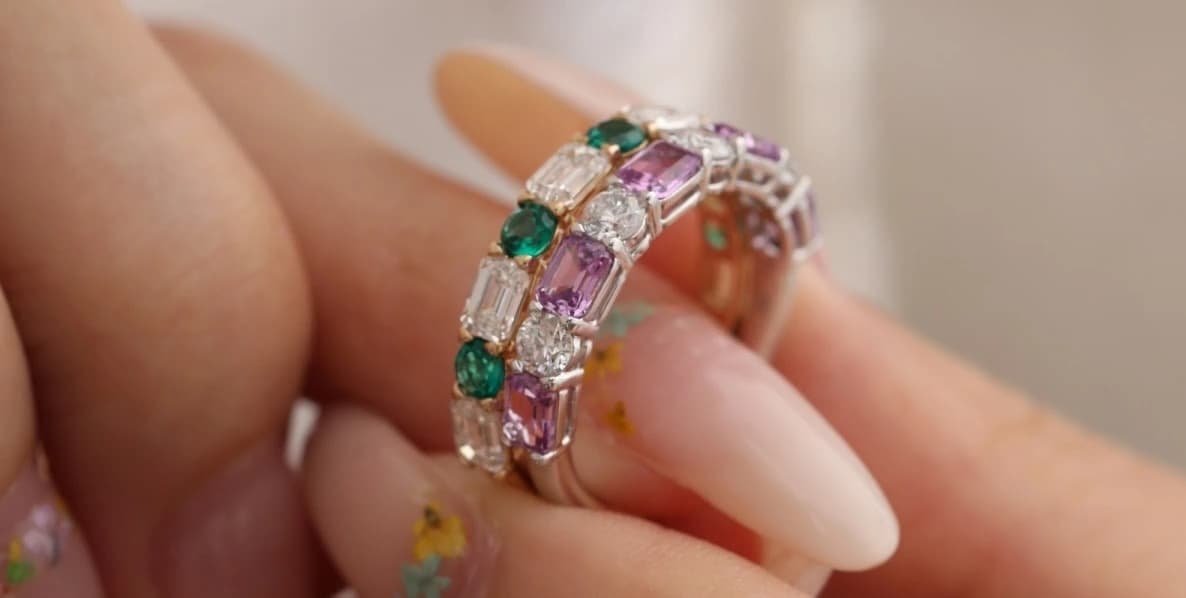
The most important C — and the most misunderstood.
Cut is frequently confused with shape (round, oval, emerald), but grading-wise it refers to the quality of the stone's faceting — the precision of its angles, symmetry, and polish. A well-cut diamond returns light to the eye efficiently, creating the brilliance and fire that makes diamonds desirable. A poorly cut stone leaks light through the bottom or sides and looks dull regardless of its colour or clarity grade. GIA grades cut as: Excellent, Very Good, Good, Fair, and Poor. IGI uses: Excellent, Very Good, Good, Fair, Poor. Always buy Excellent or Very Good. The premium over a Good cut is real, but the difference in appearance justifies it — especially in round brilliants, where cut quality has the most pronounced effect. Note that GIA and IGI only grade cut for round brilliant diamonds. For fancy shapes (oval, emerald, cushion, etc.), cut is assessed subjectively; a reputable seller will provide proportion data so you can evaluate it yourself.
D to Z — and where the real value lies.
The GIA colour scale runs from D (completely colourless) to Z (light yellow or brown tint). The grades are grouped into ranges: D–F are 'colourless,' G–J are 'near colourless,' K–M are 'faint,' and N–Z are 'light' to 'very light' colour. The practical reality: the difference between D, E, and F is invisible to the naked eye and nearly invisible under magnification. G and H stones face-up white in most settings and represent substantially better value than D–F. The colour of the setting metal also affects perceived colour: yellow gold settings make slight warmth in the stone less perceptible, meaning you can go lower on the colour scale (G–I) without visual penalty. White gold and platinum settings show colour more clearly, making near-colourless grades (G–H) a sensible floor for these settings.
What inclusions actually look like — and when they matter.
Clarity grades measure internal inclusions (crystalline features, feathers, needles) and surface blemishes on a scale from FL (flawless — no inclusions visible under 10x magnification) to I3 (inclusions visible to the naked eye). The most used grades in practice: VVS1 and VVS2 ('very very slightly included') have inclusions invisible except to a trained grader under magnification; VS1 and VS2 ('very slightly included') have inclusions visible under 10x magnification but not to the naked eye; SI1 and SI2 ('slightly included') have inclusions that may be visible to a careful naked eye in SI2 but not typically in SI1. For most buyers, VS2 or SI1 is the optimal clarity grade — you are paying for a stone with no visible inclusions, without paying the premium for characteristics only detectable under magnification. The exception is emerald and asscher cuts, which have fewer facets and show inclusions more readily — buyers of these shapes often move up to VS1.
Weight is not size — and round numbers cost more.
Carat is a unit of weight (1 carat = 0.2 grams), not a direct measure of physical size. A stone's dimensions depend on both its weight and its cut proportions — a well-cut 1ct round brilliant has a diameter of approximately 6.5mm, but a poorly cut 1ct stone cut too deep might measure 6.0mm across despite weighing the same. This is another reason cut quality matters: a well-cut stone looks larger for its weight. Price jumps sharply at round carat numbers (0.5ct, 1ct, 1.5ct, 2ct) because buyer demand concentrates at these weights. A 0.95ct stone looks virtually identical to a 1.00ct stone and costs meaningfully less. Buying just under these thresholds is one of the most effective ways to get value in diamond purchasing.
What to look for on an IGI or GIA report.
A grading certificate (or grading report) is issued by an independent laboratory and documents the stone's 4C grades along with its measurements, fluorescence, and often a plotting diagram showing inclusion locations. Key things to check: the certifying body (GIA and IGI are the most reputable; be cautious of retailer in-house grades or less established bodies), the report number (which can be verified on the issuing body's website), the 4C grades, the shape and cutting style, and the fluorescence grade. Fluorescence describes how the stone responds to UV light — faint to medium fluorescence is generally neutral or positive, while strong blue fluorescence can make a stone appear milky in direct sunlight in some cases. All lab grown diamonds sold through Quorum are IGI-certified and include a grading report that can be independently verified.
What grade of diamond should I buy?
For most buyers: Excellent cut, G or H colour, VS2 or SI1 clarity, and carat weight just under a round number (e.g. 0.95ct rather than 1.00ct). This combination gives maximum visual quality for the budget.
What does VVS mean in diamonds?
VVS stands for 'very very slightly included.' VVS1 and VVS2 diamonds have inclusions that are extremely difficult to see even under 10x magnification. They are premium clarity grades — beautiful stones, but the difference from VS1 is invisible to the naked eye.
Is GIA or IGI better for diamond grading?
Both are respected international grading bodies. GIA is generally considered the most stringent, while IGI is the leading grading body for lab grown diamonds globally. For lab grown stones, IGI certification is the industry standard.
Can I verify a grading certificate?
Yes. Both GIA and IGI have online report lookup tools where you can enter the report number and verify the grade. Always verify before purchasing.
Does a higher grade always mean a better-looking diamond?
Not necessarily. A D/FL stone with a Poor cut will look worse than a G/VS2 with an Excellent cut. Cut quality has the biggest impact on appearance. Grade differences in colour and clarity above the 'eye clean' threshold are not visible to the naked eye in everyday conditions.