Lab grown vs mined diamonds.
An honest comparison.
Most comparisons of lab grown and mined diamonds are written by parties with a financial interest in one side of the argument. This one isn't. Below is a clear, factual breakdown of how lab grown and mined diamonds compare across the dimensions that actually matter to buyers: quality, price, ethics, durability, and resale. The goal is to give you enough information to make the right decision for your situation.
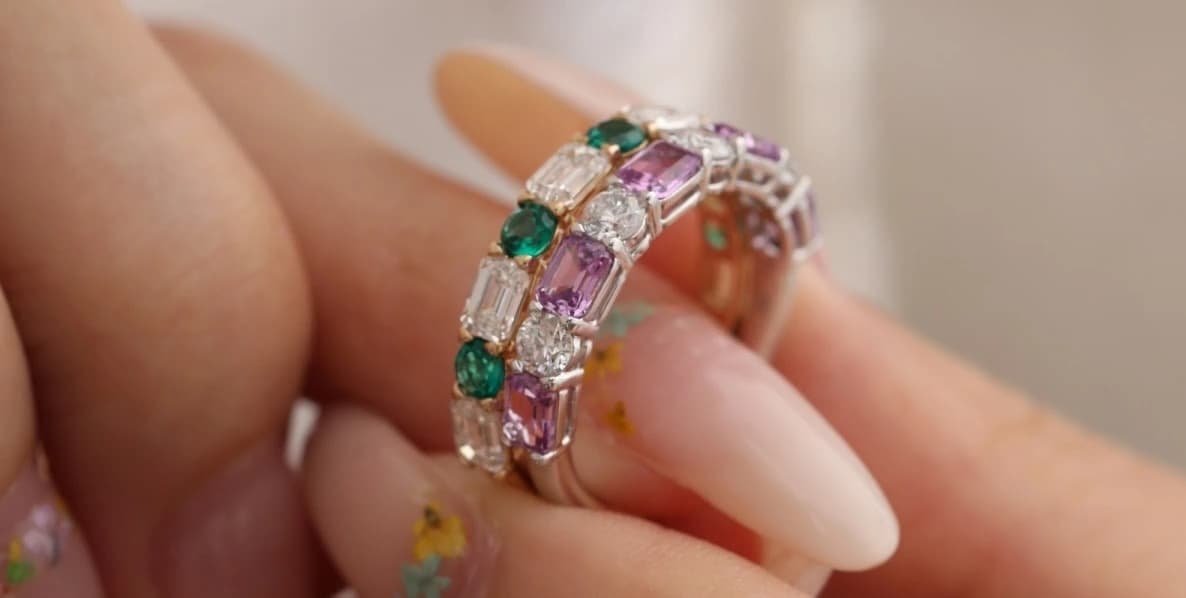
Identical by every objective measure.
Lab grown and mined diamonds are chemically and structurally identical. Both are pure carbon in a cubic crystal lattice. Both have a Mohs hardness of 10. Both have the same refractive index (2.42) and the same thermal conductivity. Both are graded using the 4C framework — Cut, Colour, Clarity, and Carat — by the same independent bodies (GIA, IGI). The grade of a stone, not its origin, determines its visual quality. A D/VVS1 lab grown diamond is objectively higher quality than a G/SI2 mined diamond. Origin is not a quality criterion — it is a provenance criterion.
Lab grown diamonds cost 60–80% less for the same grade.
Price is where the difference becomes significant. A 1ct round brilliant, D colour, VS1 clarity mined diamond retails for approximately $5,000–$8,000 depending on cut quality and seller. The same grade in a lab grown diamond retails for approximately $800–$1,500. The difference is not quality — it is supply chain. Mined diamond prices reflect centuries of consolidated supply, significant marketing investment (most famously, De Beers' 'A Diamond Is Forever' campaign, which created the expectation of diamond engagement rings from scratch), extraction costs, and multi-layer distribution. Lab grown diamonds have a shorter supply chain, scalable production, and no extraction premium. At Quorum, group buying compresses prices further — direct-to-manufacturer ordering at wholesale volume removes the retailer's margin on top of the lab grown price advantage.
Lab grown diamonds offer full traceability and lower impact.
The ethics of mined diamonds have been a subject of sustained scrutiny. While the Kimberley Process was established to reduce conflict diamonds in the supply chain, it has significant gaps: it doesn't cover diamonds funding abusive regimes (only armed rebel movements), and traceability remains imperfect across artisanal mining operations. Environmental impact is also material: diamond mining displaces large volumes of earth, disrupts local ecosystems, and generates significant carbon emissions per carat. Lab grown diamonds offer a categorically different profile. They are produced in known facilities with documented processes. Carbon footprint per carat is substantially lower, and there is no land disruption. For buyers who care about supply chain ethics, lab grown diamonds provide certainty that mined diamonds cannot match at scale.
No practical difference over a lifetime of wearing.
Some older marketing material suggested lab grown diamonds were somehow less durable than mined — this is not supported by gemology. Both have a Mohs hardness of 10. Both are resistant to scratching by any common material. Both are suitable for all jewellery types, including rings which receive the most wear. The durability of a finished piece depends on the setting and metal quality, not on whether the diamond is lab grown or mined. At Quorum, all pieces are set in solid metals (gold or sterling silver) by professional manufacturers — the setting quality is identical regardless of stone origin.
Neither category retains retail value well — and that's the honest answer.
The resale value question is where honest comparison requires nuance. Mined diamonds have historically been marketed as holding value, but the reality is that most retail jewellery — mined or lab grown — sells secondhand at a significant discount to its purchase price. The difference is that mined diamond prices are relatively stable at the wholesale level (supported by coordinated supply management), while lab grown diamond wholesale prices have declined substantially as production has scaled. If you are buying jewellery as an investment, neither lab grown nor mined diamonds are reliable vehicles — jewellery's value is in wearing it, not in its liquidation price. If the question is purely sentimental or practical — 'will this piece hold up, will it look beautiful, will it mean something' — lab grown diamonds are the rational choice on every dimension except resale speculation.
Can you tell the difference visually between lab grown and mined diamonds?
No — not with the naked eye, and not with standard gemological equipment. Specialised instruments can detect differences in growth patterns, but for all practical wearing purposes the stones are visually identical.
Is a lab grown diamond considered 'genuine' for insurance?
Yes. Insurers treat lab grown diamonds the same as mined diamonds for jewellery insurance, particularly when accompanied by an IGI or GIA grading certificate.
Will my partner be able to tell it's lab grown?
Only if you tell them — or if they take it to a specialist gemologist with specific detection equipment. The visual appearance is identical. Whether to disclose is a personal decision, but there is nothing to 'hide' in a physical sense.
Are lab grown diamonds a recent development?
The first gem-quality lab grown diamonds were produced in the 1950s, but the technology to produce them at commercial scale and gem quality took until the 2010s to mature. GIA has been certifying them since 2007.
Does Quorum sell mined diamonds?
No. Quorum exclusively uses lab grown stones. This is a deliberate choice — it gives us full supply chain traceability, consistent pricing, and aligns with the values of buyers who want ethical sourcing without compromise.