Yes. Lab grown diamonds are real diamonds.
Here is the science behind that answer.
The question 'are lab grown diamonds real?' is one of the most searched questions in jewellery today — and the answer is unambiguous. Lab grown diamonds are not simulants, not imitations, and not a compromise. They are diamonds in every meaningful sense: same crystal structure, same hardness, same optical properties, same grading standards. The only difference is origin.
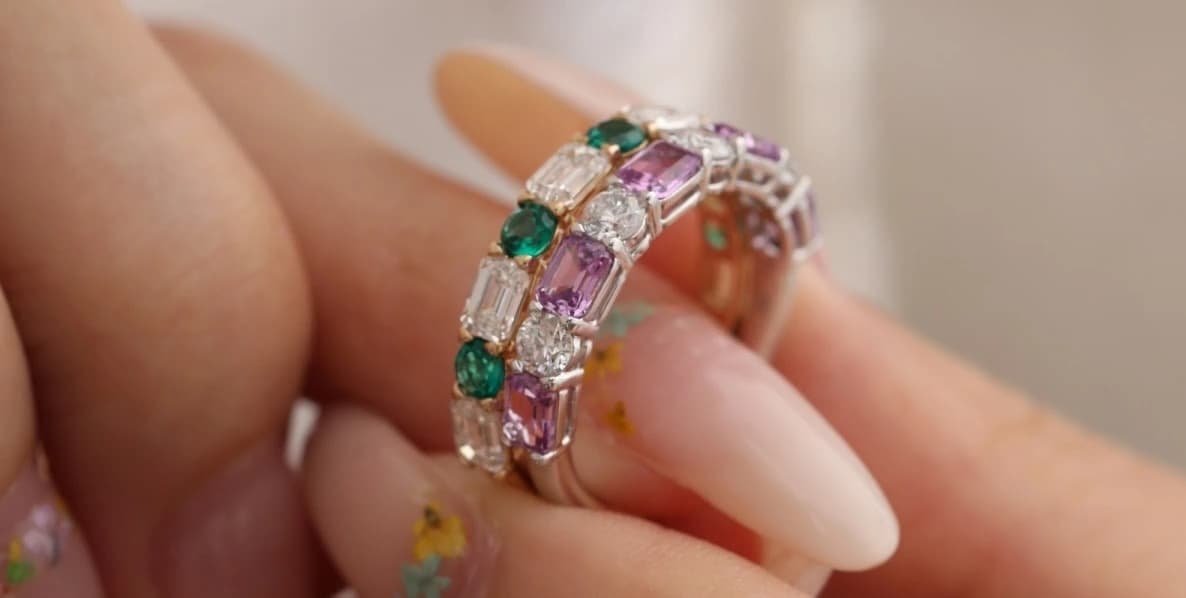
Same atoms. Same structure. Same diamond.
A diamond — mined or lab grown — is pure carbon arranged in a cubic crystal lattice. That structure is what gives diamond its defining properties: a Mohs hardness of 10 (the maximum), exceptional thermal conductivity, and the characteristic brilliance that comes from a refractive index of 2.42. Lab grown diamonds are produced by replicating the exact conditions that create diamonds in the earth's mantle — either through High Pressure High Temperature (HPHT) processes or Chemical Vapour Deposition (CVD). Both methods result in a stone with the same carbon atom arrangement as a mined diamond. There is no chemical difference. A gemologist cannot distinguish one from the other with the naked eye, and neither can a standard spectrometer.
Graded by GIA and IGI — on the same 4C scale.
The Gemological Institute of America (GIA) and the International Gemological Institute (IGI) — the two most respected grading bodies in the world — both grade lab grown diamonds using the same 4C framework applied to mined diamonds: Cut, Colour, Clarity, and Carat. GIA began issuing grading reports for lab grown diamonds in 2007. IGI followed and has since become the leading grading body for lab grown stones globally, issuing reports that are accepted by jewellers, insurers, and resellers worldwide. When you buy a lab grown diamond through Quorum, it comes with an IGI certificate that documents its exact 4C grade — the same report format used for mined diamonds.
Moissanite and cubic zirconia are not diamonds. Lab grown ones are.
The confusion often comes from conflating lab grown diamonds with diamond simulants — stones that look like diamonds but are chemically different. Cubic zirconia (CZ) is zirconium dioxide. Moissanite is silicon carbide. Both are beautiful stones in their own right, but neither is a diamond — lab grown or otherwise. A lab grown diamond is not a simulant. It is not 'diamond-like.' It is a diamond. The distinction matters not only for accuracy but for how the stone behaves over time: only diamond achieves a Mohs hardness of 10, which is why diamond is the only stone that can scratch itself and resists surface wear over a lifetime of wearing.
Origin — and what that means for price and ethics.
The only objective difference between a lab grown diamond and a mined diamond is how it came to exist. Mined diamonds form over billions of years under extreme geological conditions and are extracted through mining operations that carry significant environmental and social costs. Lab grown diamonds are produced in weeks in controlled facilities, with full traceability, no mining disruption, and a dramatically lower carbon footprint per carat. Because the supply chain is shorter and the extraction cost is absent, lab grown diamonds cost significantly less than mined equivalents of the same grade — typically 60–80% less at retail. At Quorum, we compound that saving further through direct-to-manufacturer group buying, so you receive the benefit of both the lab grown price advantage and wholesale-level pricing.
You are not making a trade-off. You are making a better choice.
Choosing a lab grown diamond is not settling for less. It is choosing a stone that performs identically to a mined diamond in every wearable sense — hardness, brilliance, durability — while paying less, knowing the origin, and avoiding the ethical complexity of the mined supply chain. For buyers who want a 1ct D/VS1 brilliant cut stone without paying five figures, lab grown diamonds are not a workaround. They are simply the rational choice. Quorum's group buy model takes this further: by pooling orders, we negotiate directly with manufacturers at wholesale volumes, removing the retailer markup that even standalone lab grown diamond sellers still charge.
Can a jeweller tell the difference between a lab grown and mined diamond?
Not with the naked eye, and not with standard gemological tools. Specialised equipment (such as De Beers' DiamondView) can identify growth patterns that distinguish the two — but for all practical purposes of wear, beauty, and function, they are indistinguishable.
Do lab grown diamonds come with grading certificates?
Yes. All lab grown diamonds sold through Quorum come with an IGI grading report documenting Cut, Colour, Clarity, and Carat weight — the same report format issued for mined diamonds.
Will a lab grown diamond lose its sparkle over time?
No. Brilliance in a diamond comes from its refractive index and cut — both of which are properties of the stone's crystal structure, not its origin. A lab grown diamond will maintain the same optical properties as a mined diamond indefinitely.
Are lab grown diamonds insurable?
Yes. Major insurers treat lab grown diamonds the same as mined diamonds for jewellery insurance purposes, particularly when accompanied by a grading certificate.
Do lab grown diamonds hold their value?
Lab grown diamond prices have declined as production has scaled, and resale value reflects that. However, the same is true of mined diamonds — most jewellery does not retain its retail value at resale. If long-term resale value is a priority, both types should be considered with that caveat in mind.